In the workshops along the rue de la Tabletterie in fourteenth-century Paris, craftsmen carved small ivory plaques to serve as covers for writing tablets. These were luxury goods—delicate scenes of courtship and devotion rendered under trefoil arches, meant to enclose smooth sheets of ivory with recessed areas filled with wax, on which poems or messages could be inscribed with a stylus. The tablets were intimate objects, exchanged as love tokens or gifts of courtly favor.
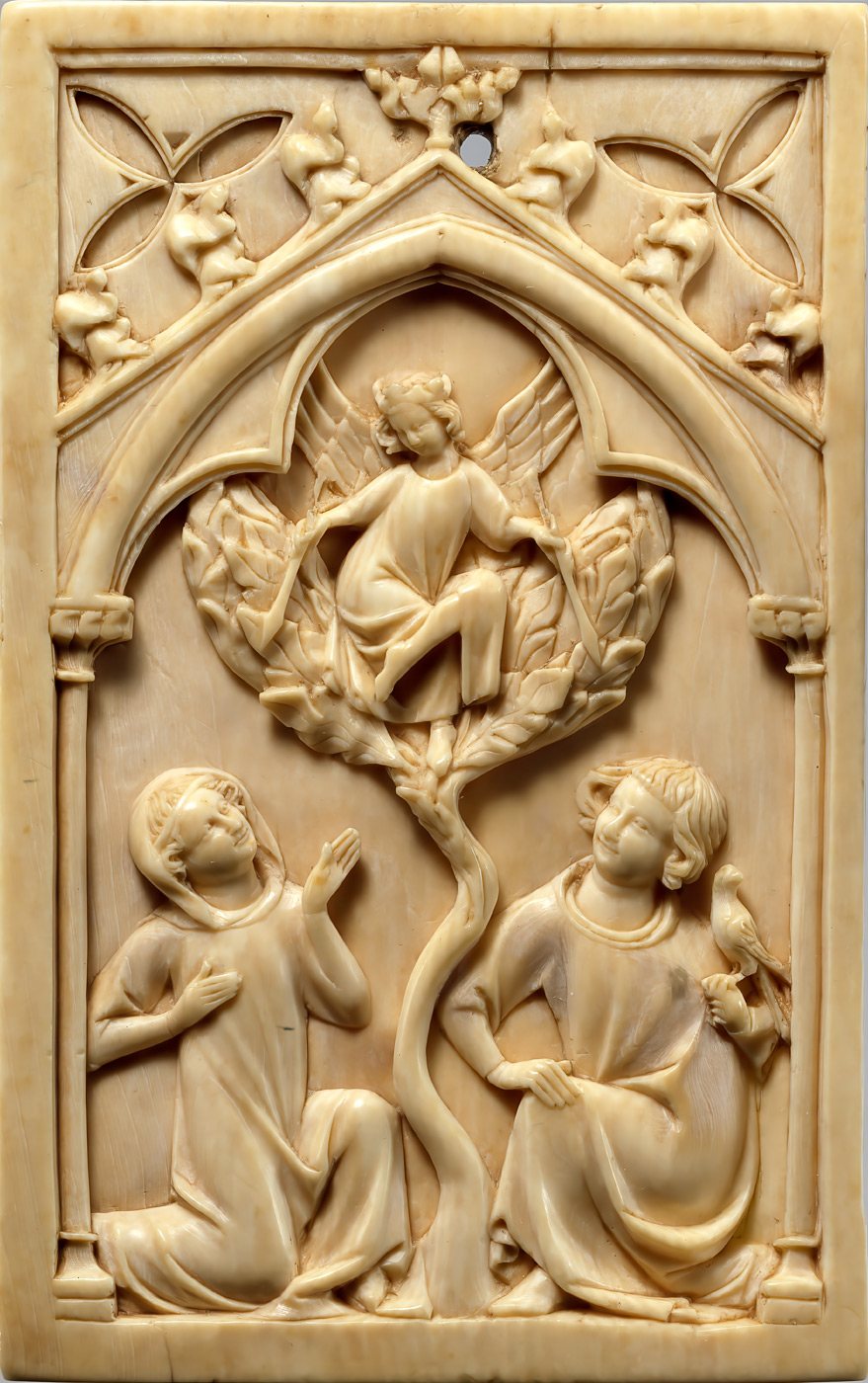
One such plaque, carved around 1325–50, survives in the collection of The Metropolitan Museum of Art, on view at The Cloisters in Gallery 14. It depicts scenes of courtship beneath an elegant Gothic trefoil arch, its ivory surface still crisp after nearly seven hundred years.
The original ivory, ca. 1325–50. The Metropolitan Museum of Art. 1 / 3
The Reconstruction
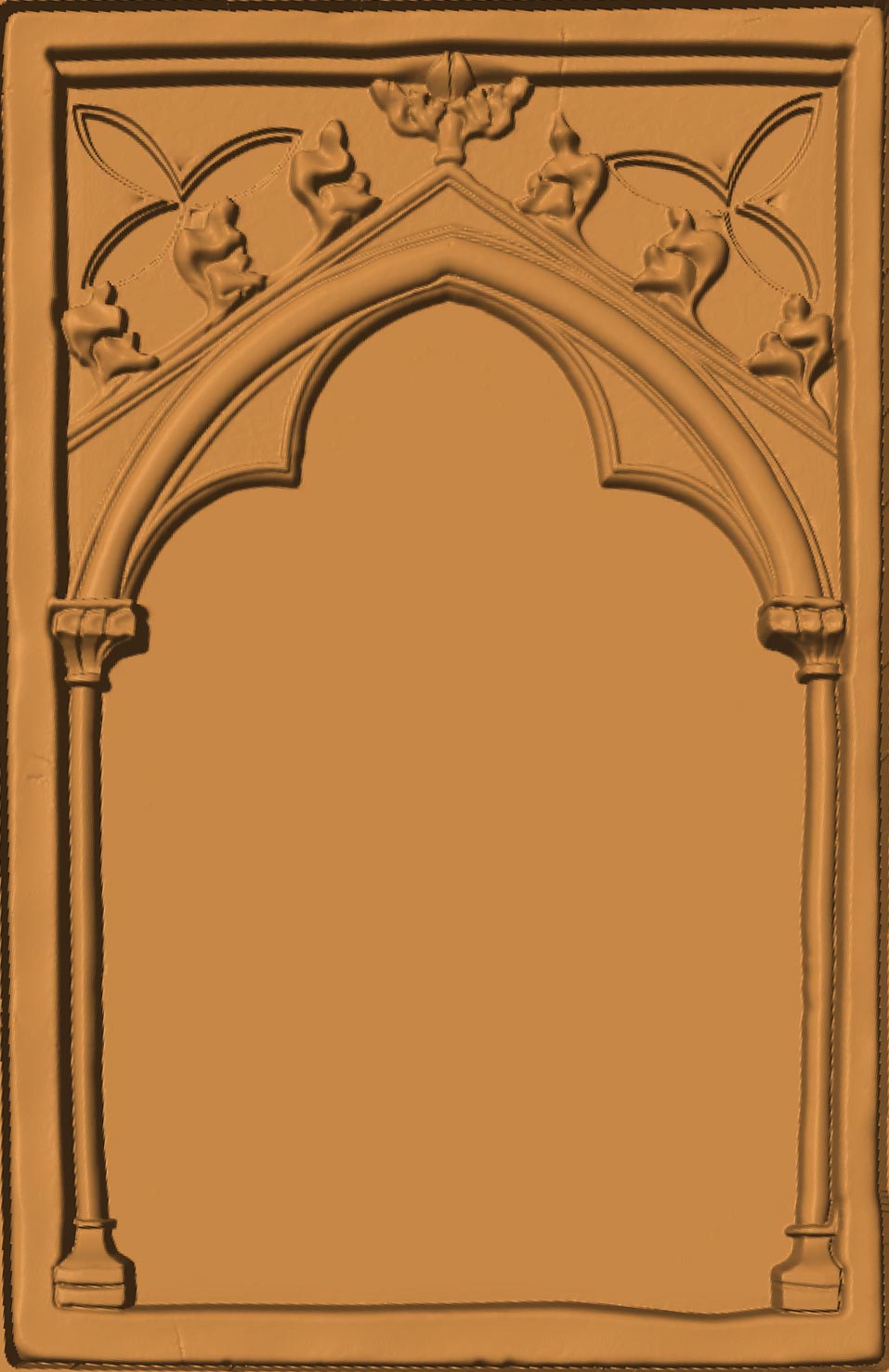
This project began not in a workshop, but in Photoshop. Working entirely from photographs available on The Met’s website—without ever seeing the original in person—the trefoil arch was digitally reconstructed as a height map: a 16-bit grayscale bitmap in which lighter values represent higher surfaces and darker values represent deeper ones. The result is, in effect, a three-dimensional sculpture rendered in two dimensions.
The process was painstaking. Each design element of the arch was redrawn on its own layer, with relative heights interpreted by eye and blended together into a single coherent surface. Tool marks and subtle irregularities were deliberately included, lending the height map the character of hand-carved work rather than the sterile precision of a CAD model. No 3D scanning was used. The entire redaction—nearly eighty hours of work—amounted to a laborious act of visual archaeology, reading depth from a flat photograph, and translating it into a format a machine could understand.
The resulting bitmap was then imported into the CarveWright software environment, which translated the grayscale values into toolpaths for a compact benchtop CNC carving machine.
The Carving
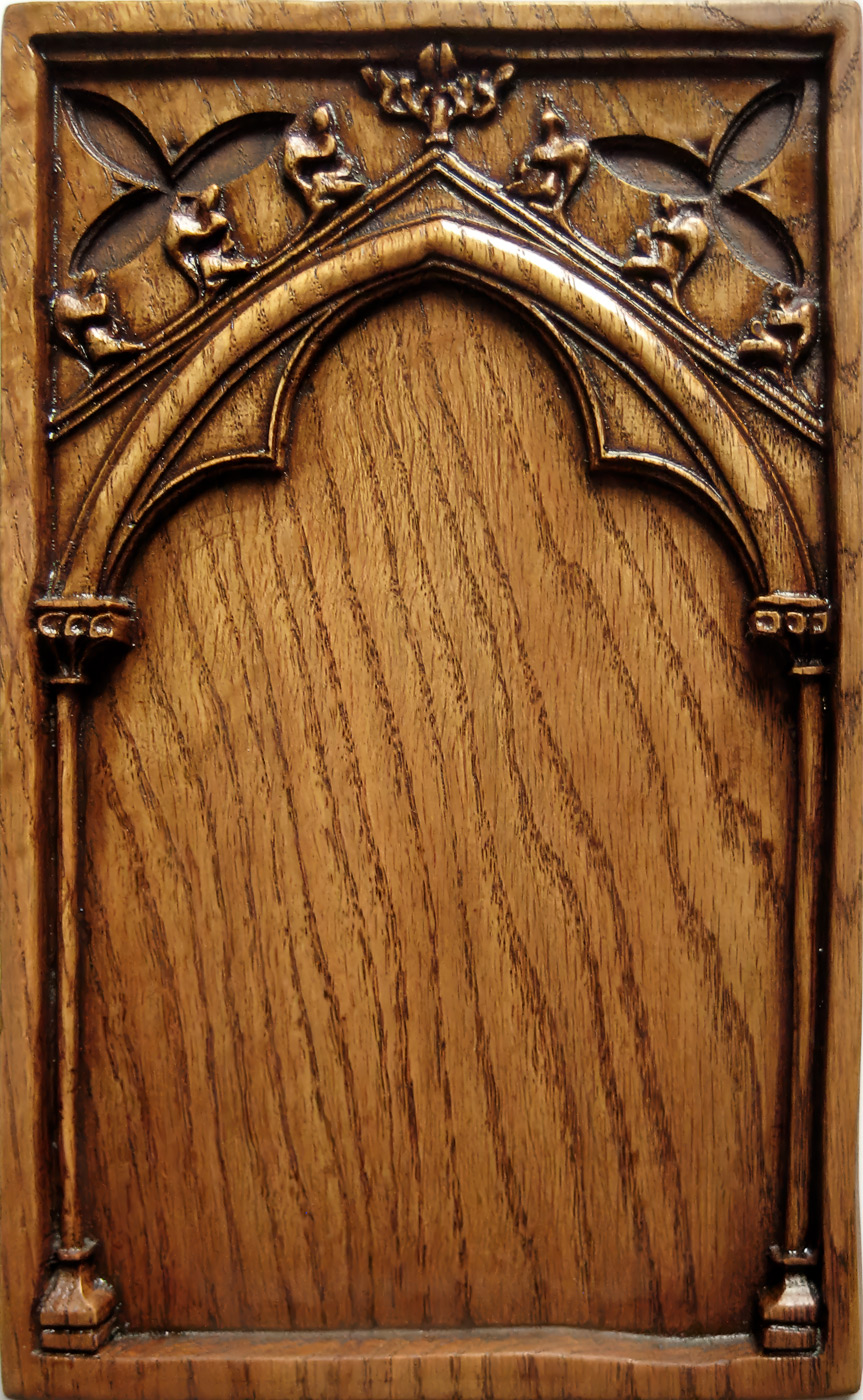
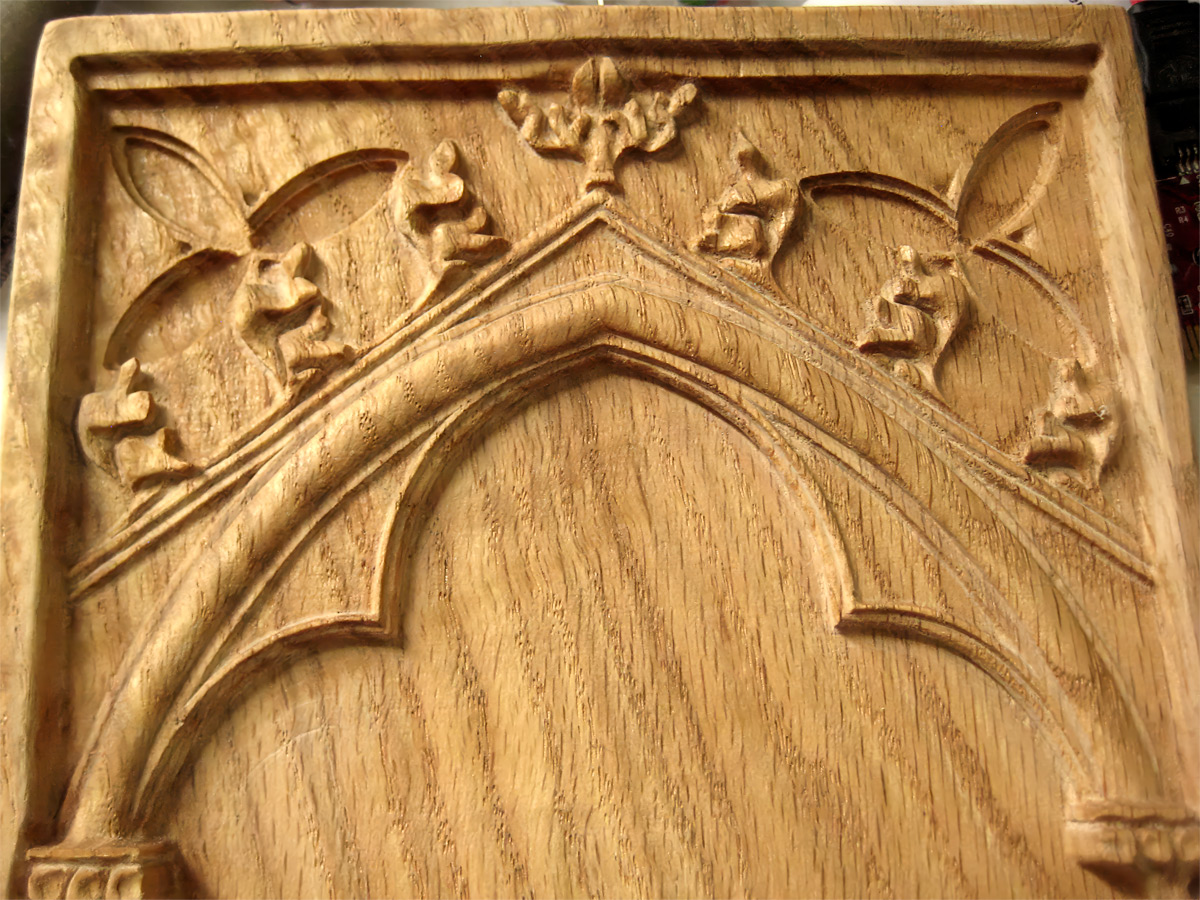
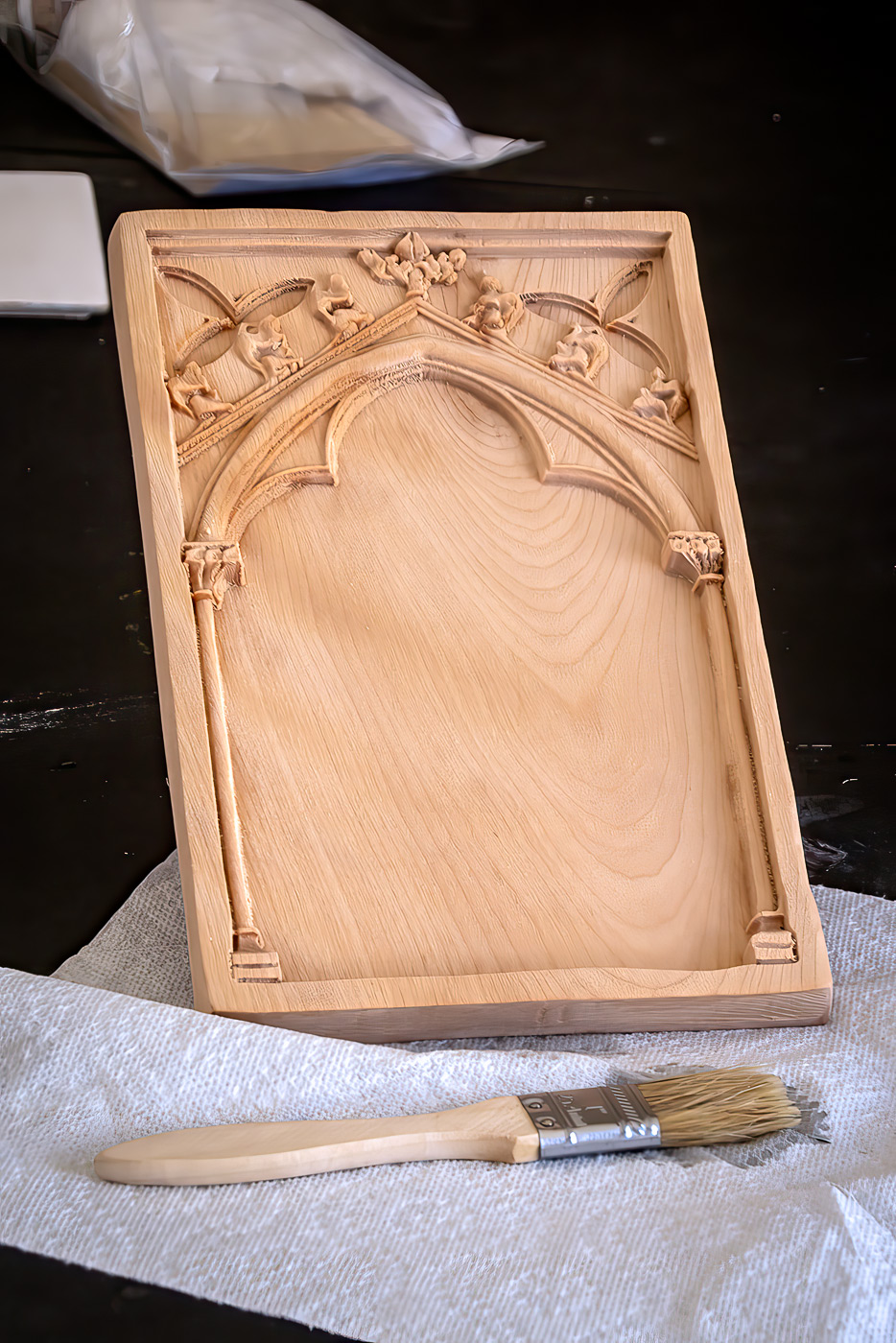
The first piece was cut in white oak—a natural for durability, and the ability to hold fine detail. Oak was the obvious choice for a showpiece, even though the hardness of the wood made hand-carving a more demanding proposition. The CNC machine laid down the broad forms, but the real character of the piece emerged from the work that followed.
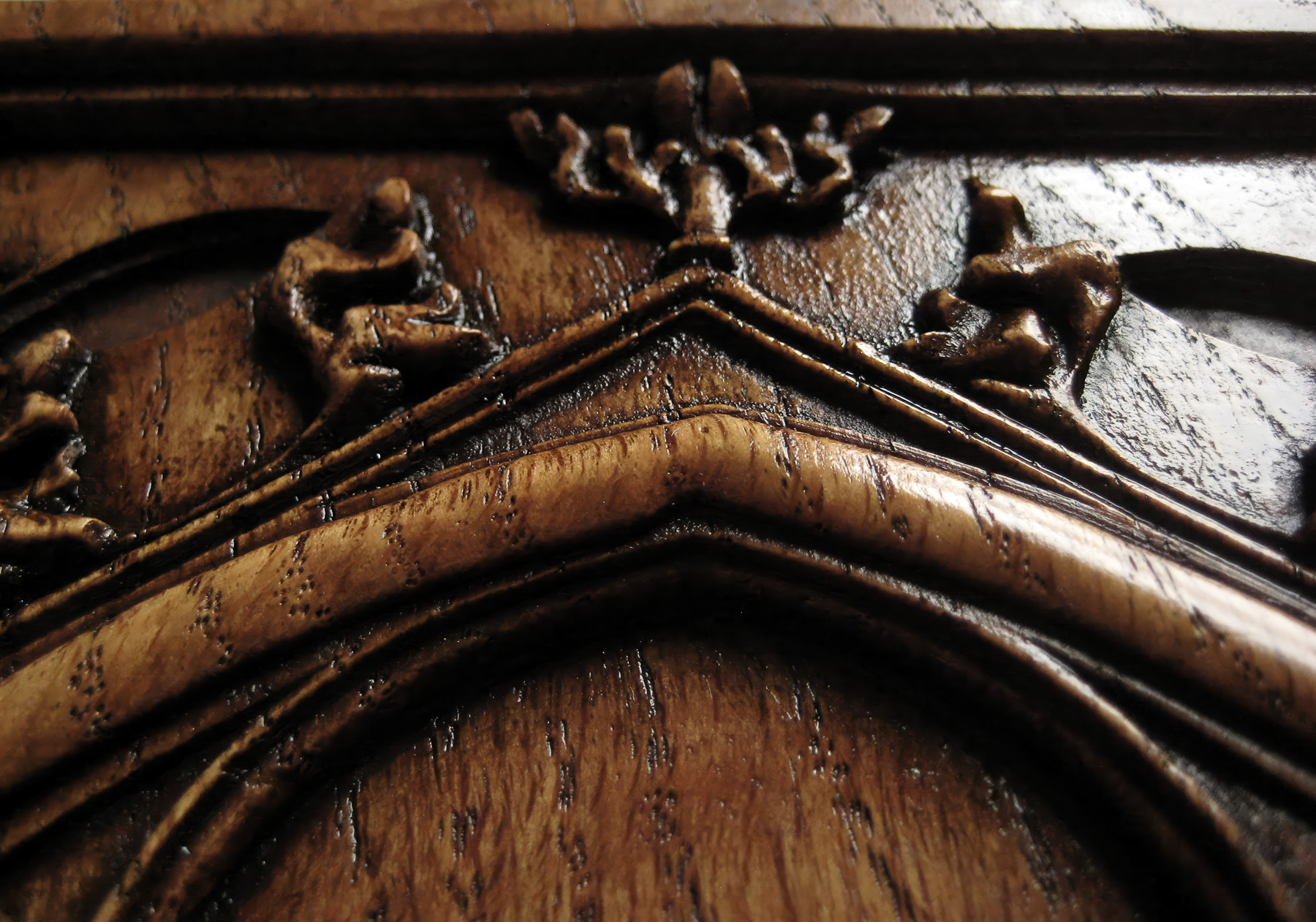
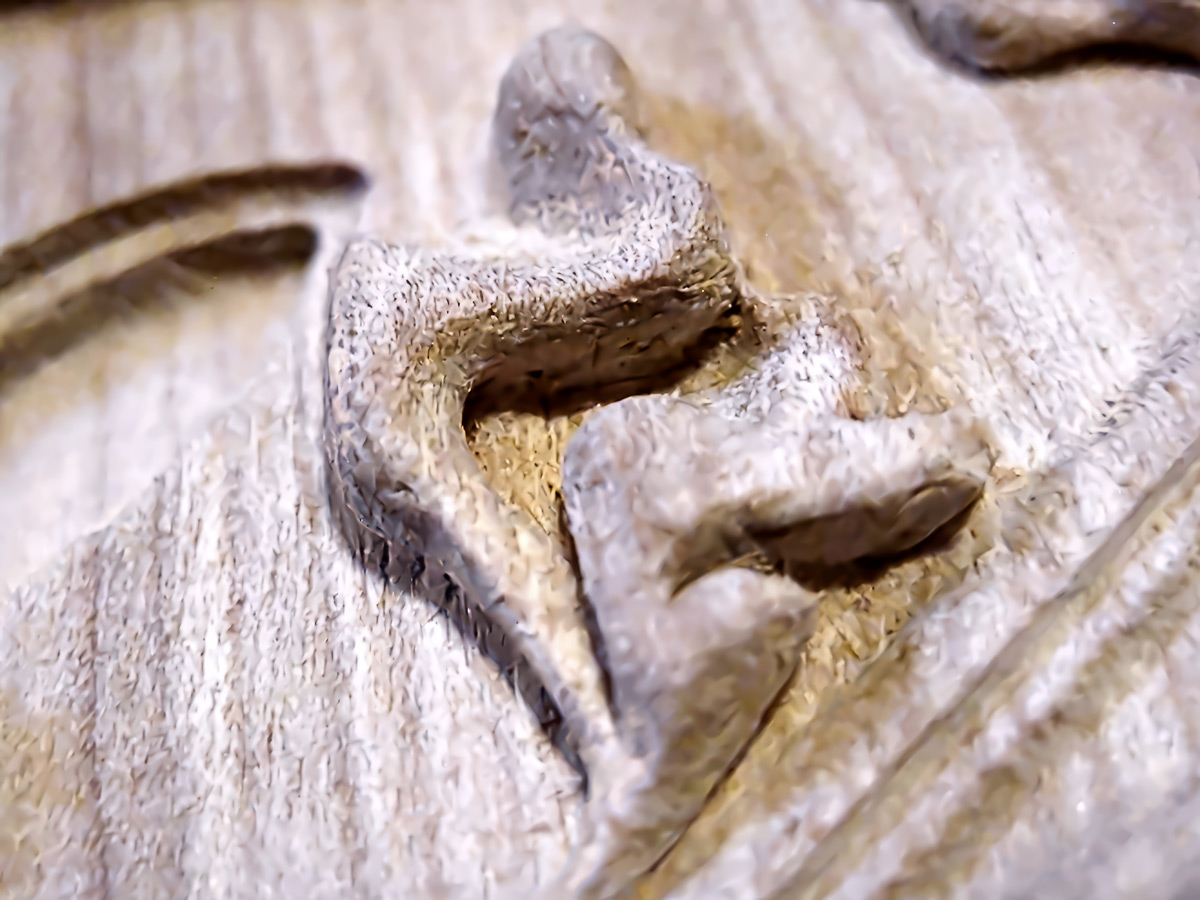
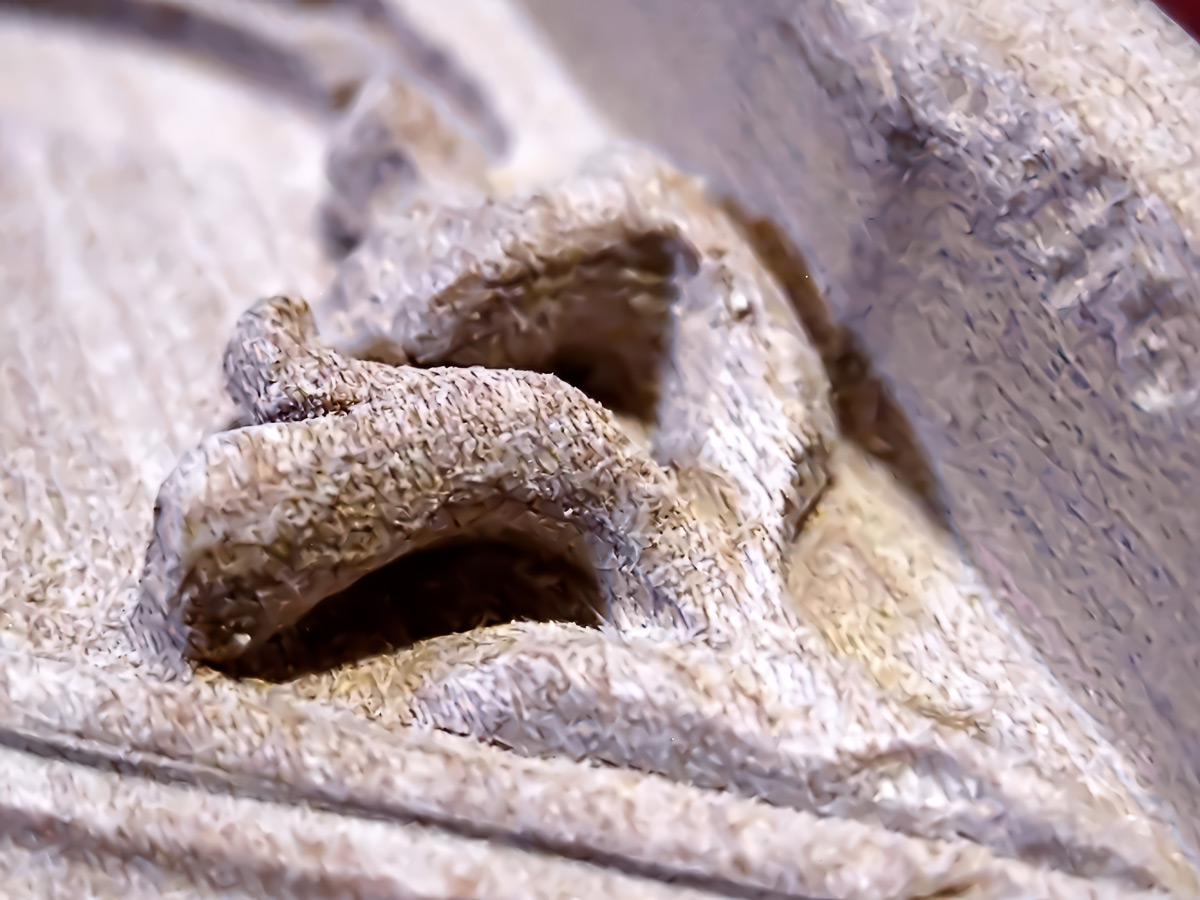
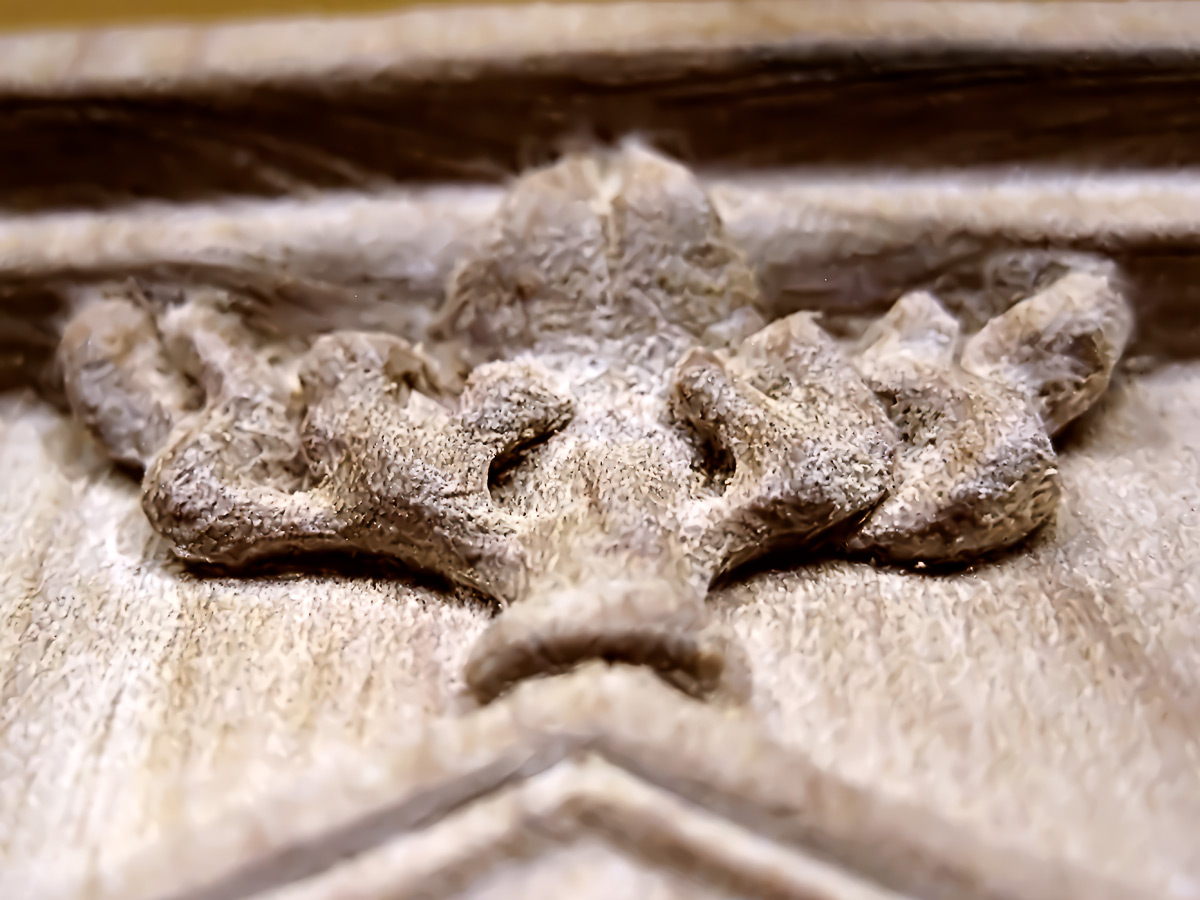
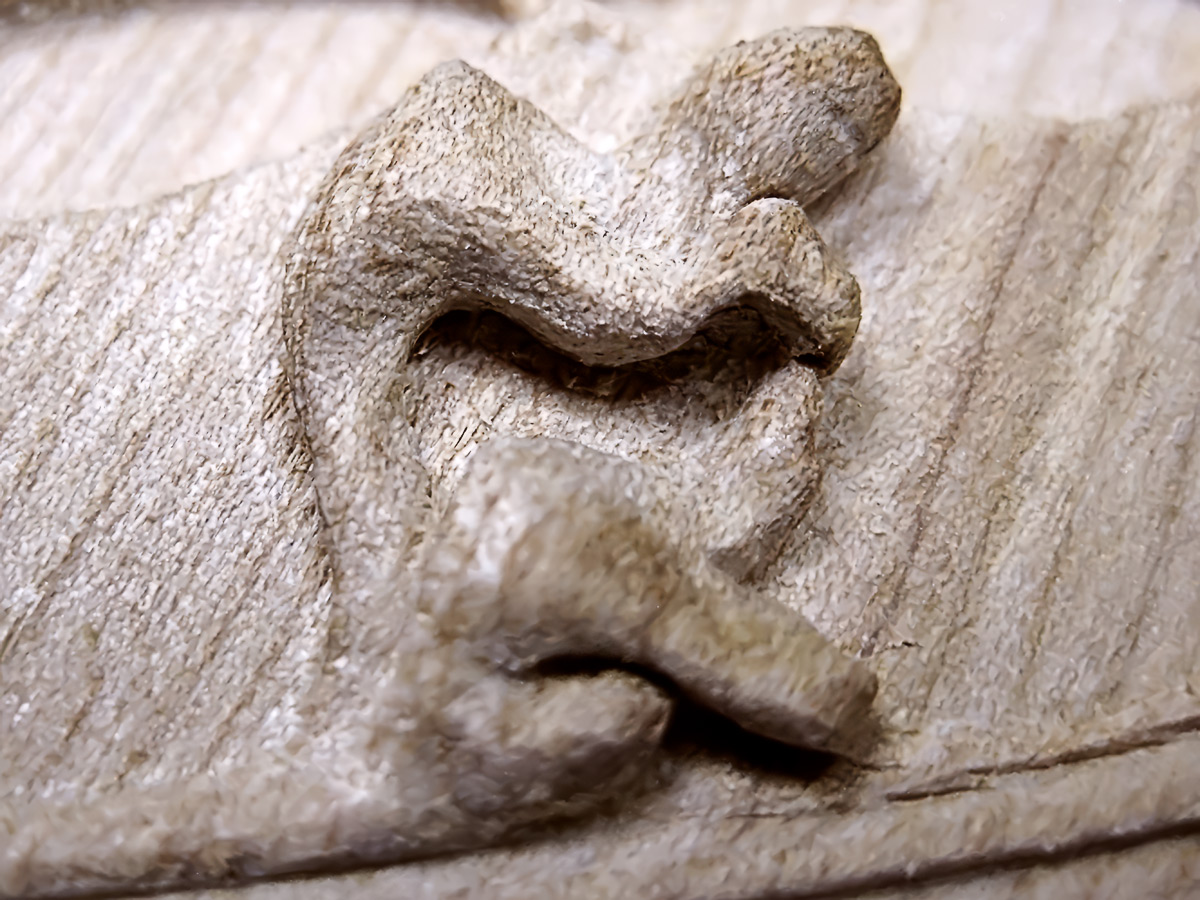
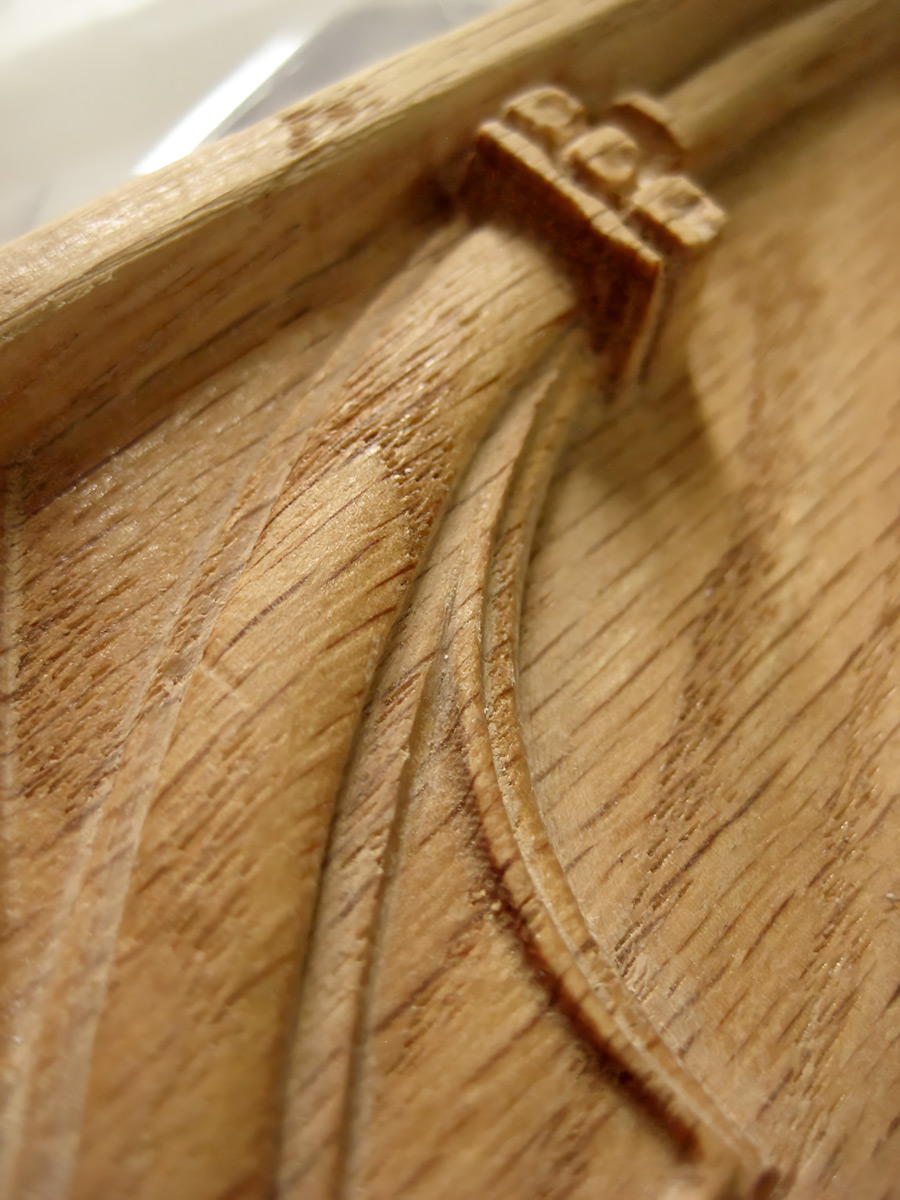
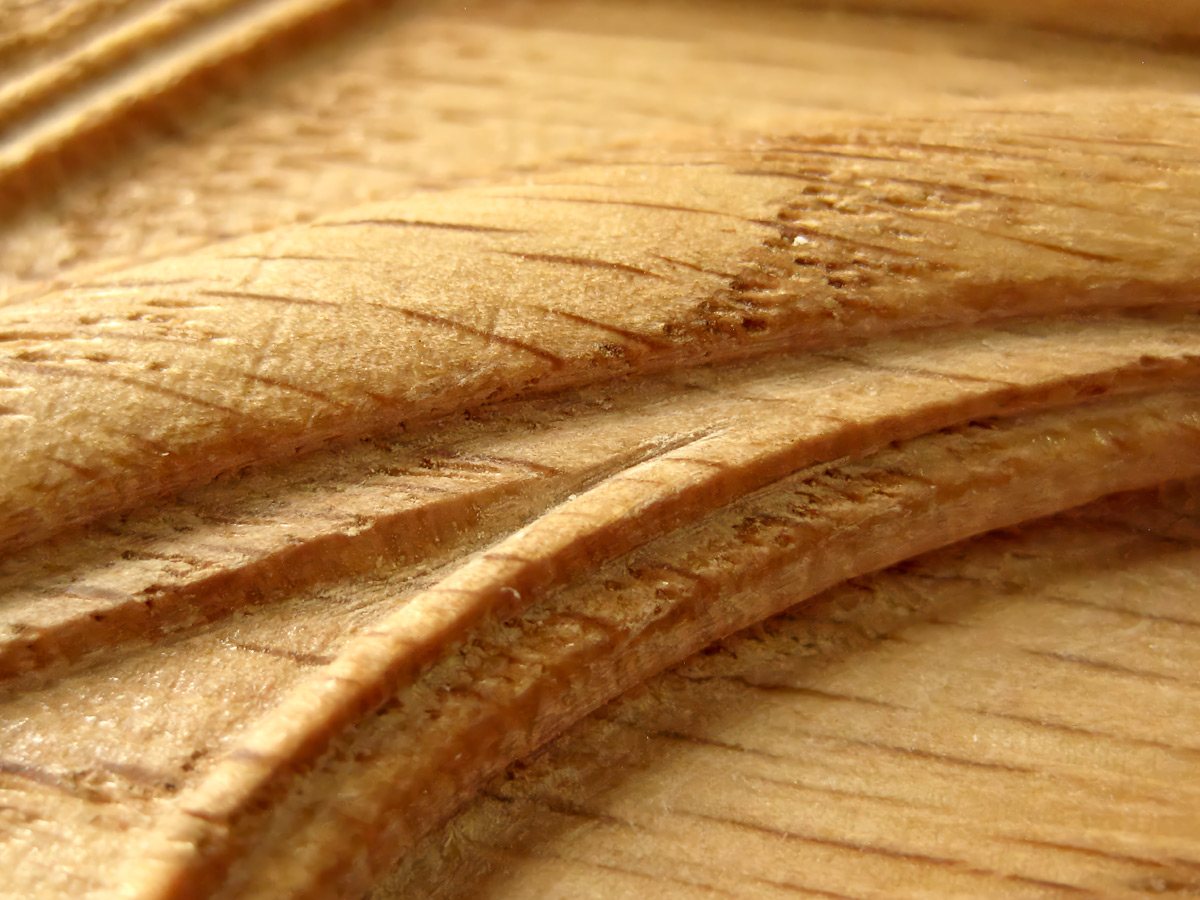
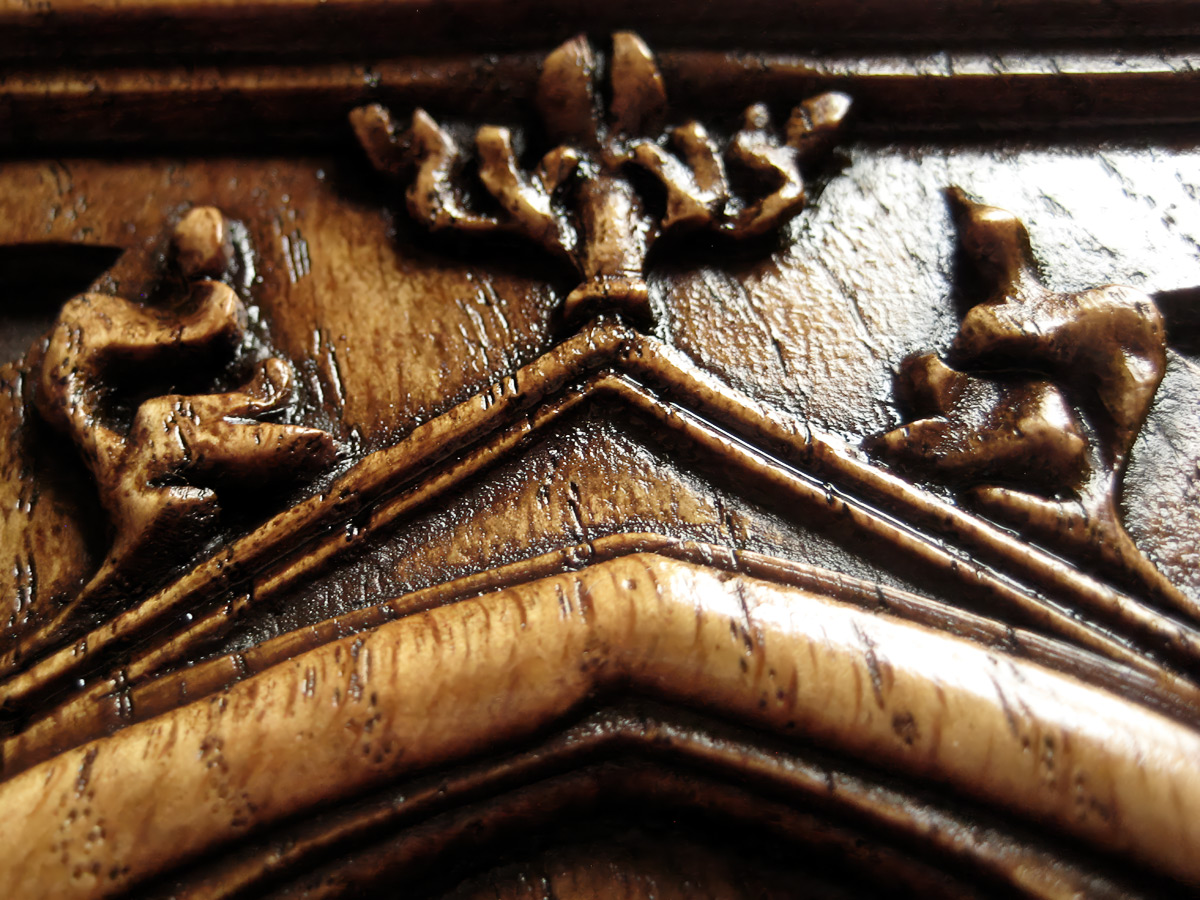
Two stages of hand detailing refined the machine’s output. Using very fine carving chisels of varying blade profiles—all kept murderously sharp—the carved surface was brought to a level of crispness and subtlety that no machine pass alone could achieve. The majority of this work was the addition of undercuts: places where the carved surface curves back under itself, creating true three-dimensional depth and shadow. Undercuts are impossible for the CarveWright to produce—its bit can only descend vertically from above—so every undercut is the mark of a human hand.
The Finish
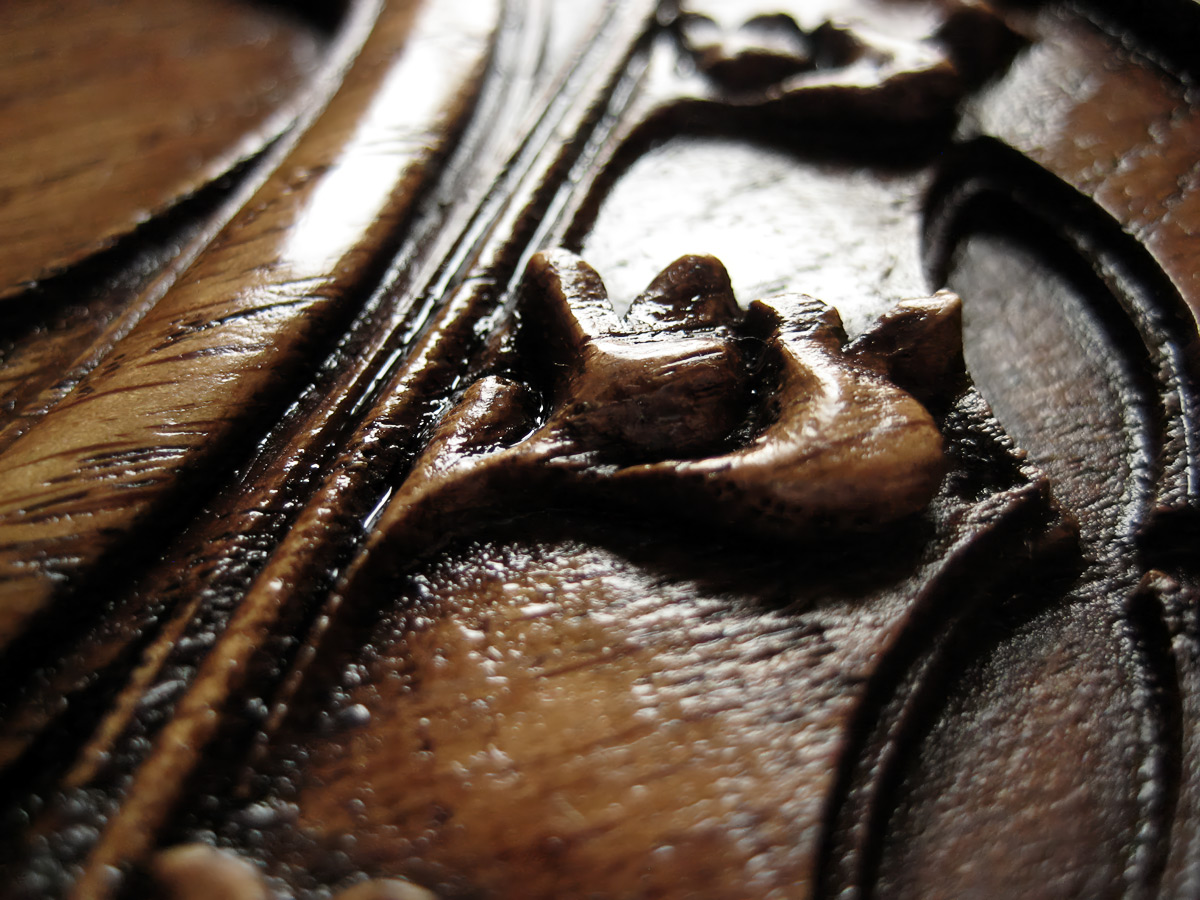
The finished panel cried out for an antique appearance. A combination of wood stain and brown shoe polish was applied, with the shoe polish serving as an antiquing glaze—settling into the recesses to deepen the shadows while the high points were rubbed back to reveal the lighter wood beneath. A light coat of linseed oil sealed the surface.
Once the initial sheen settled into a warm matte, the final product looks as if it’s far older than it really is.
Process
Detail: undercuts on a crocket 1 / 10
A Blank Slate
The decision to reproduce only the architectural frame—omitting the figural elements of the original—was initially a time constraint. However, it quickly became apparent that without figures, the panel becomes a blank slate for further artistic use, and this is precisely what happened. The medieval design, digitally reconstructed and machine-carved, became the substrate for yet more medieval craft.
The figural elements of the original remain a future ambition. Work has begun on the tree. But the frame alone has proven so versatile in its applications that there has been no urgency to fill the space beneath the arch.
In the Workshop
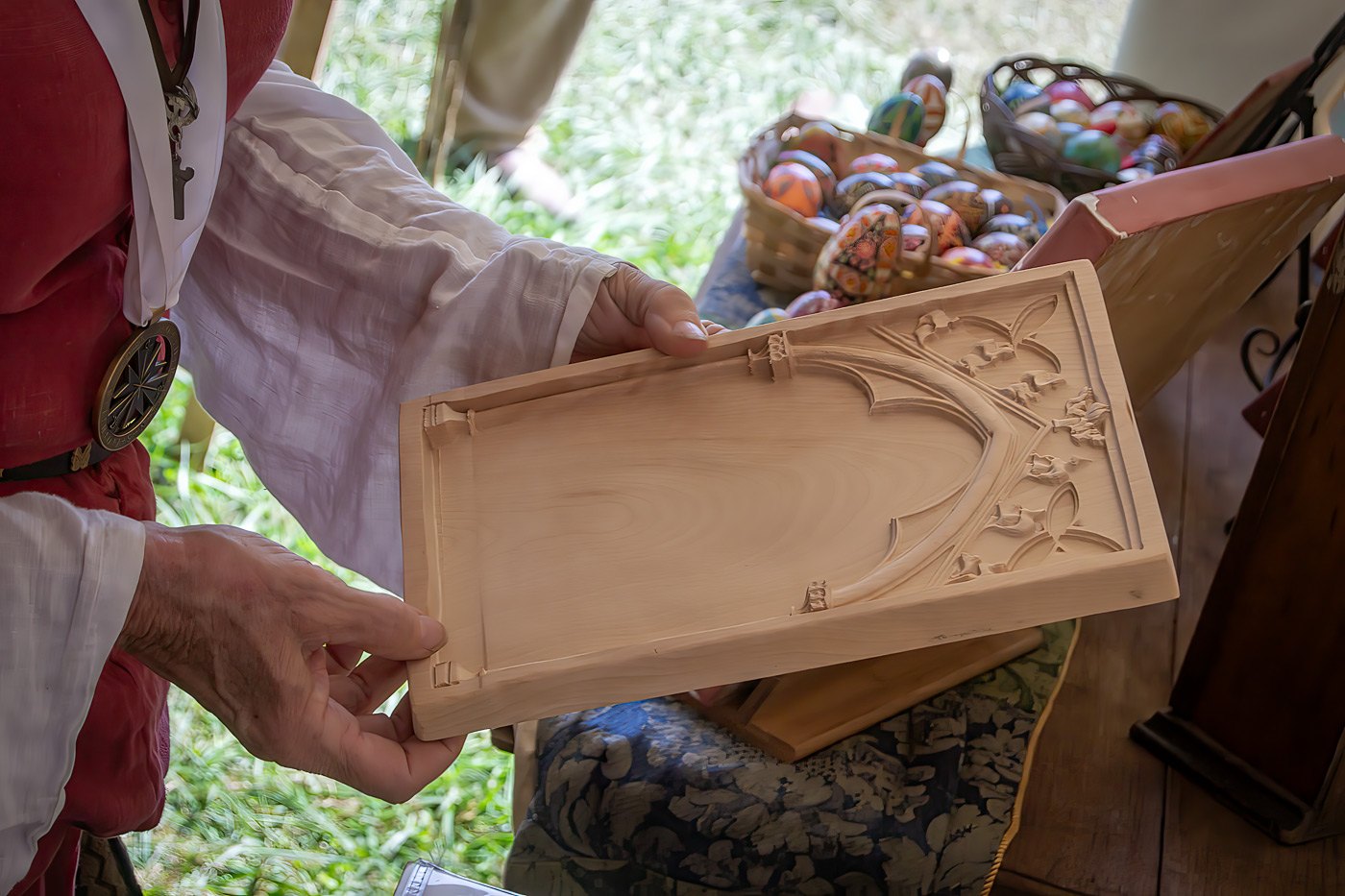
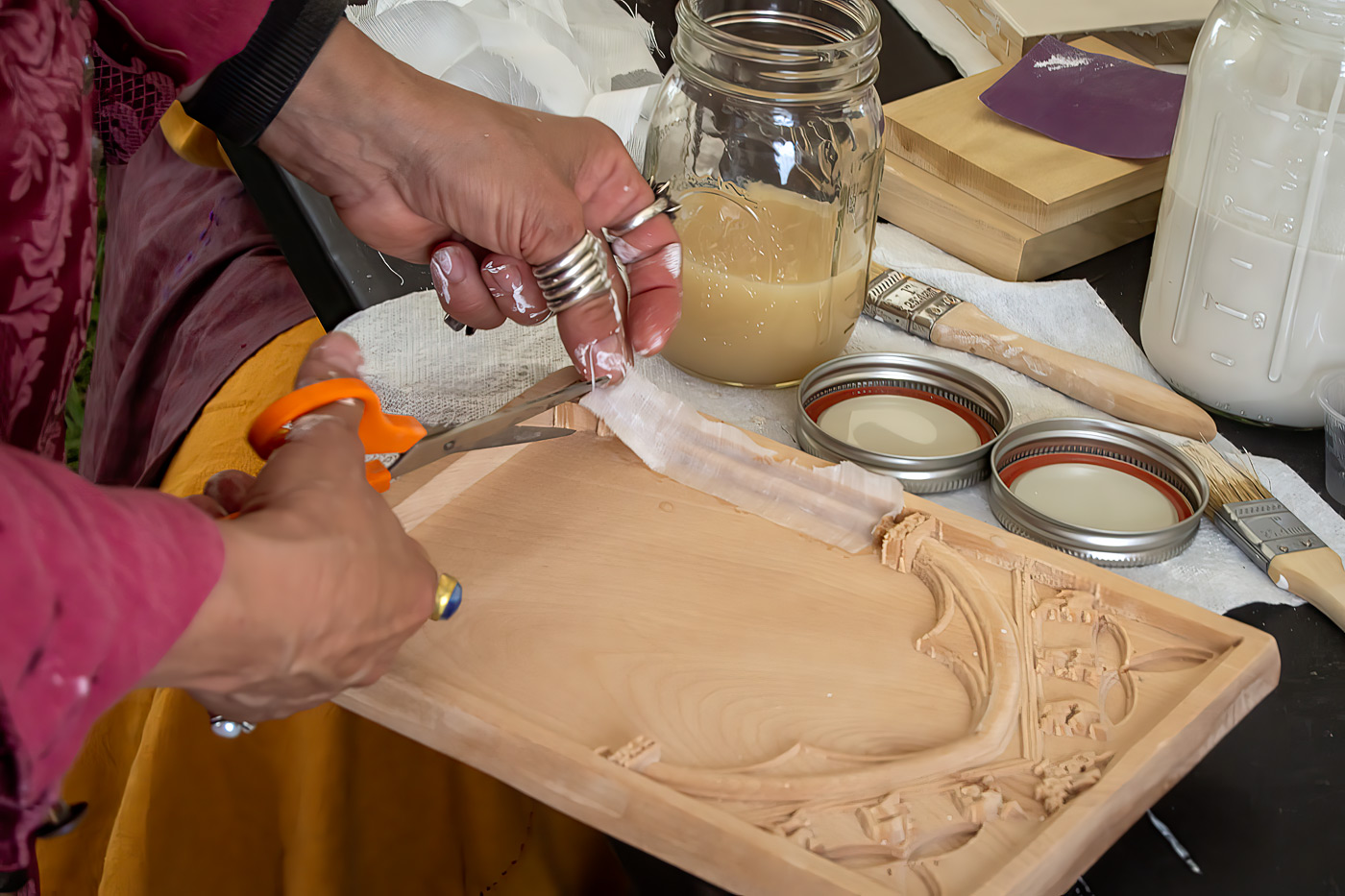
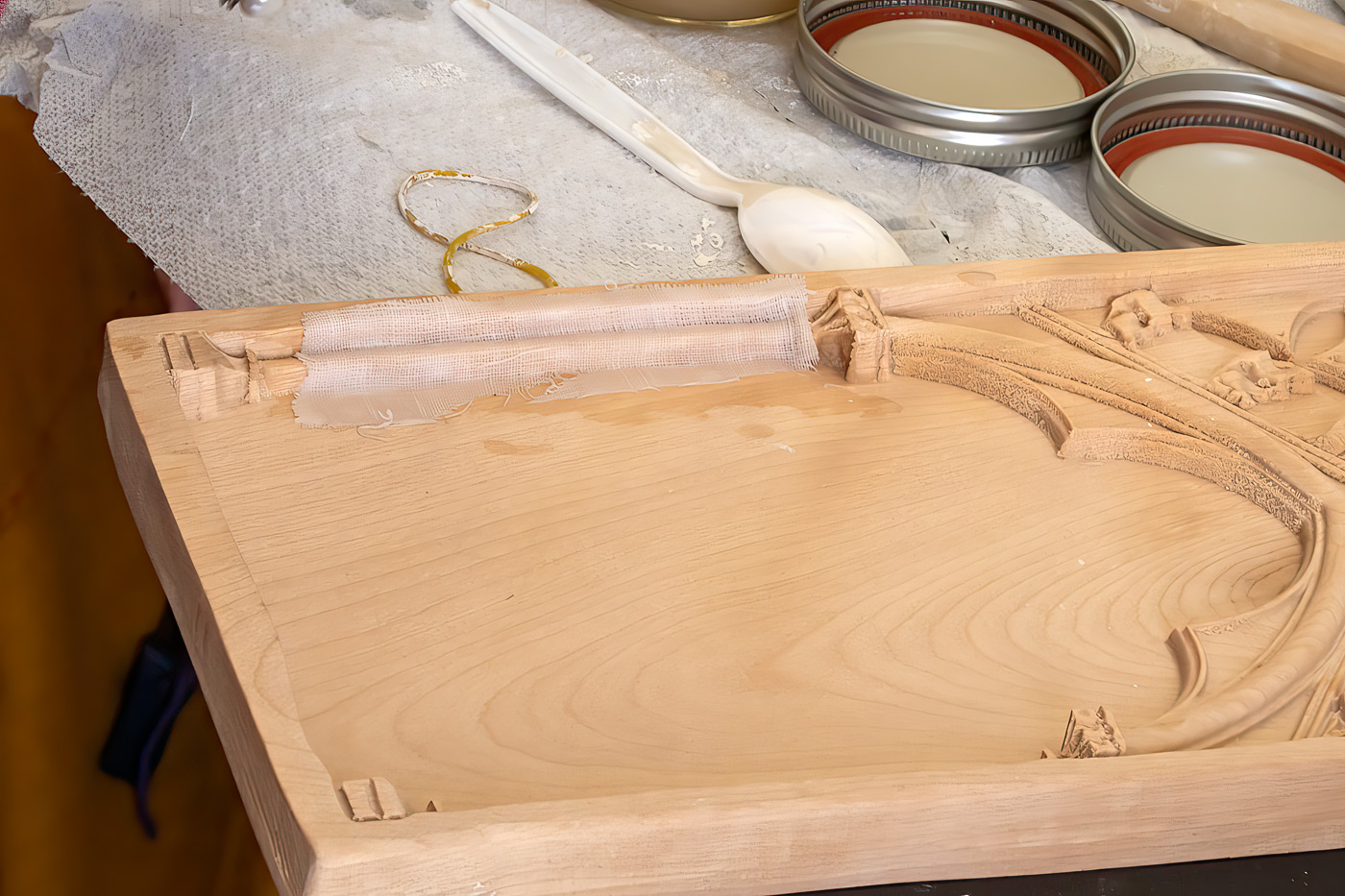
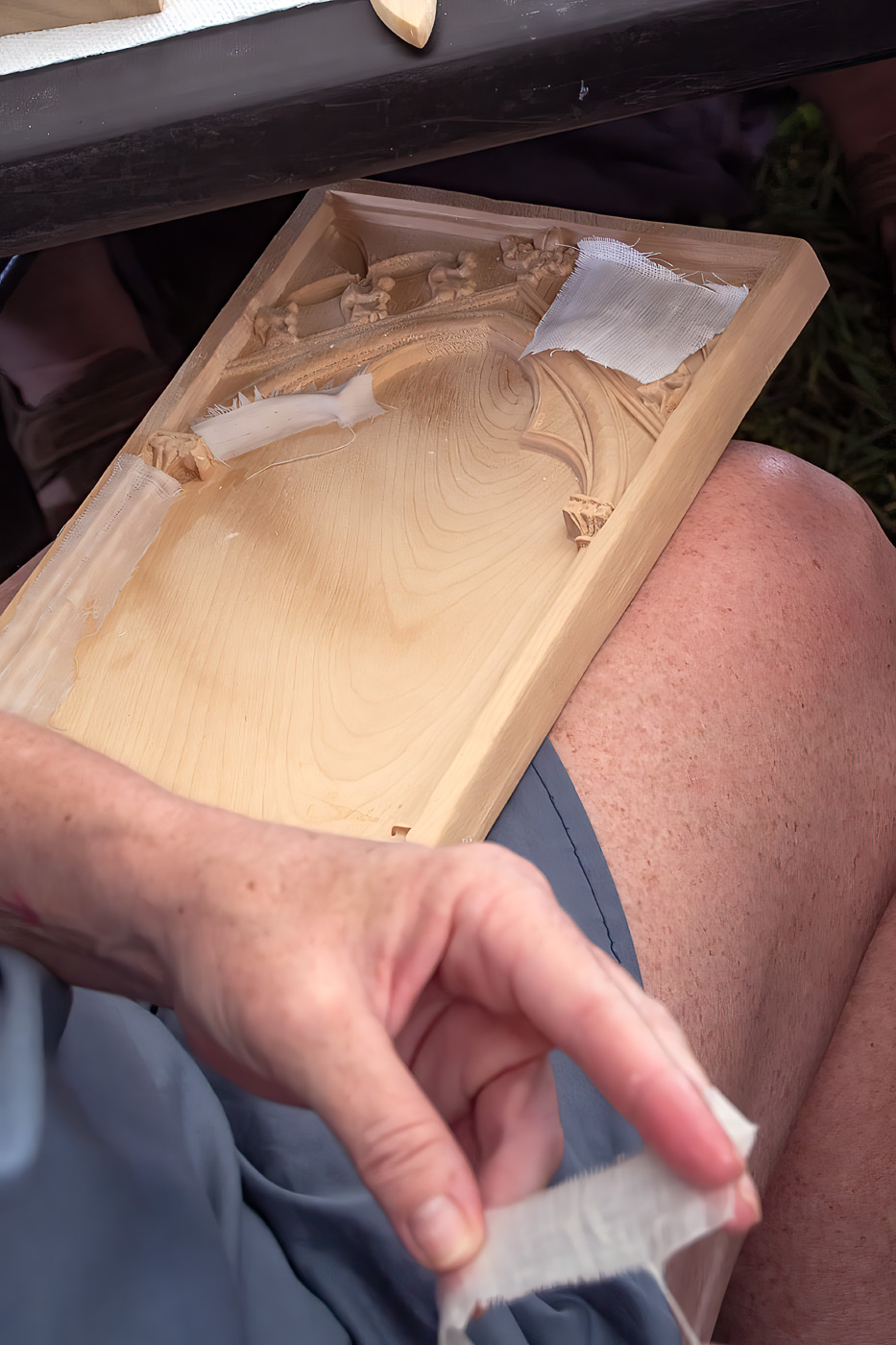
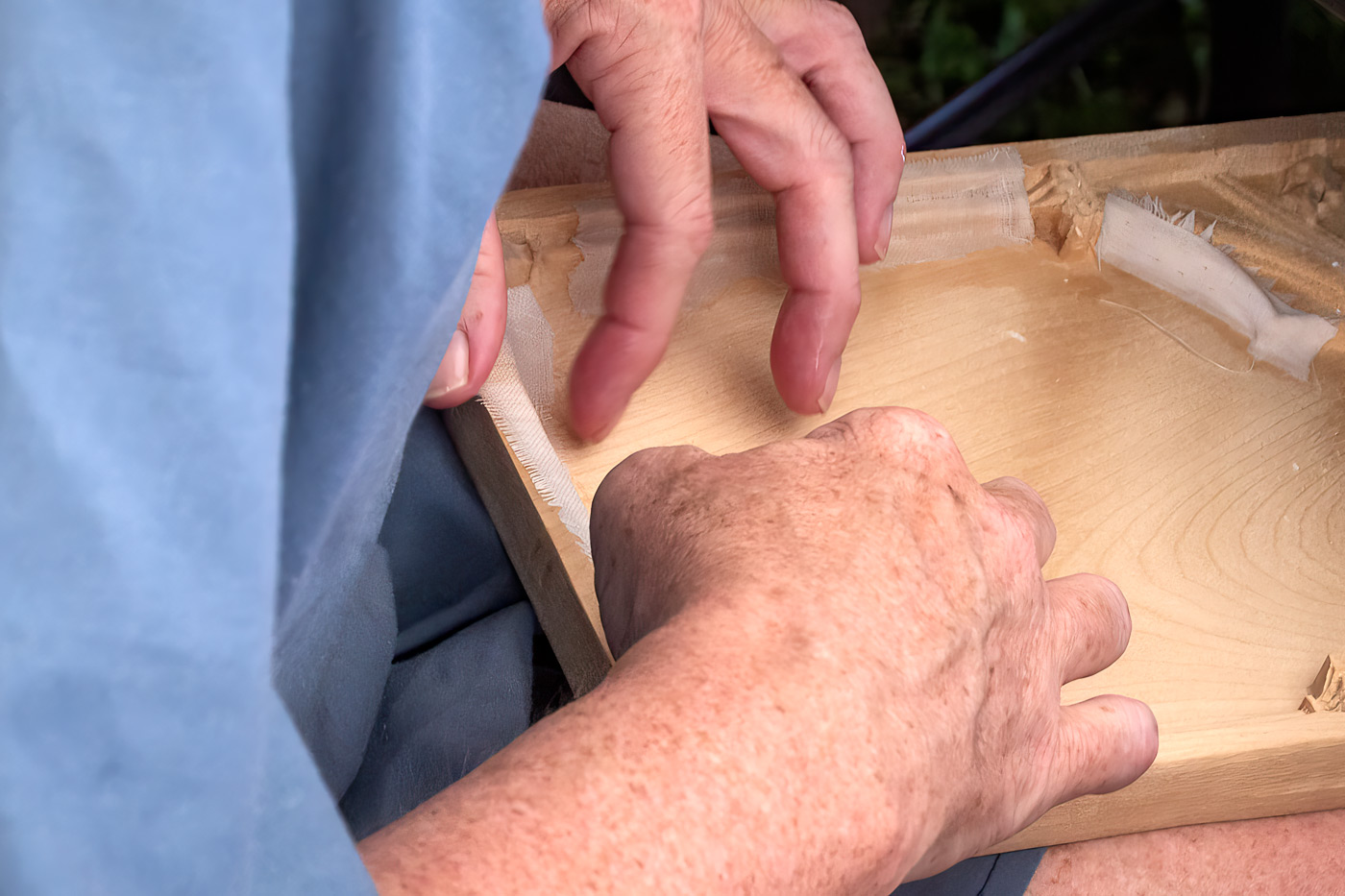
Beech panels—carved but unfinished—were ultimately offered for sale at the Pennsic War. Not only did the panels prove popular, they caught the attention of artisans studying gilding and egg-tempera painting over carved gesso. In this technique, the carved panel is first covered in linen soaked in rabbit-skin glue. Once dry, the linen-covered surface is coated with gesso, which is then carved again to bring back the detail of the original design—a second carving echoing the first. The resulting surface is ready for the application of gold leaf and/or paint. The photographs below are from a class on this technique. It was a true honor to have inspired such creativity.
A panel being offered for sale 1 / 6
Panel dimensions: approximately 7″ tall
Original ivory: 3 11/16 × 2 5/16 × 5/16 in. (9.3 × 5.9 × 0.8 cm)
Original ivory: Cover of a Writing Tablet, ca. 1325–50, French.
The Metropolitan Museum of Art, New York, The Cloisters Collection, 2003
(accession 2003.131.3a, b).
Image courtesy of The Metropolitan Museum of Art, Open Access / CC0.
Reconstruction and carving by Daniel del Cavallo, 2019.